


|
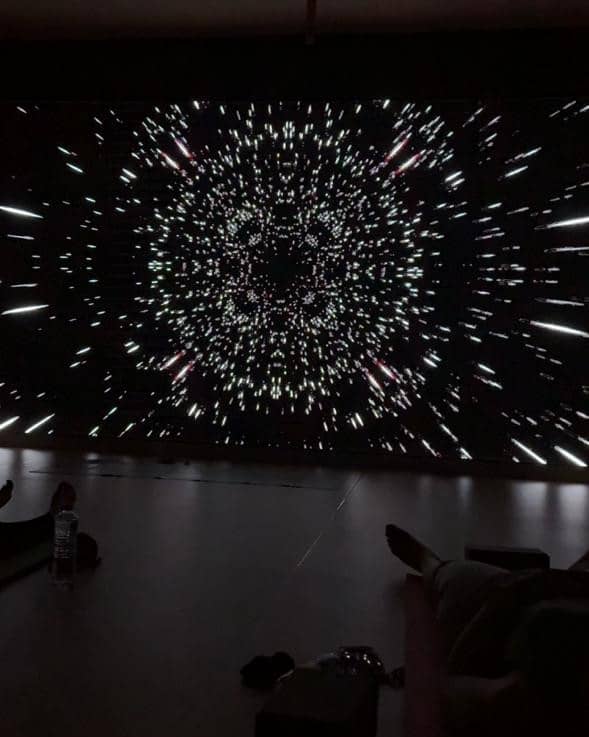
Dear Reader, I’ve been going to sensory flow yoga classes lately more than usual, and in one session during Savasana, I decided not to lie down. I sat still and kept my eyes open, watching this trippy, universe-looking visual projected on the wall.
Somewhere deep in that meditation, I imagined I was floating inside it – surrounded by tiny particles moving around me, like a fast-motion montage of my entire life. And then this question struck me: “Am I the one arriving at life? Sit with that for a moment because you may miss the depth of this question. Have you ever wondered whether life simply arrives to you and you meet it at the pace it’s meant to? Does your speed really shape your outcomes? Because if we can’t force life to arrive sooner, then what exactly are we rushing for? I went down a rabbit hole exploring these questions – meditating on them, researching them, and honestly… obsessing a little. So this week, I want to share this thought with you through different lenses. Here are four ways to look at the same question, depending on what you believe about time, destiny, speed, and the way life unfolds: “Does Life Arrive to You, or Do You Arrive to Life?”1. The Abrahamic LensIn Christianity, Islam, and Judaism, there’s a shared idea that God already knows the full arc of your life – every slowdown, acceleration, detour, mistake, redemption. Life unfolds toward you like a script God has read but you haven’t. And yet, free will also exists. You still choose how you meet each moment. As the Book of Deuteronomy says: “I have set before you life and death… choose life.” In practice, this means:
What I find comforting here is the idea that while you don’t control the existence of the waves, you can choose how to surf them. Even in scripture, there are moments where human prayer influences the divine outcome – like Moses interceding after the golden calf incident (Exodus 32), or Abraham pleading for Sodom (Genesis 18). 2. The New AgeIn New Age thought, your energy, beliefs, and emotional frequency shape the version of reality you tune into. From this lens:
Two questions this lens invites:
Because the universe might not care about how fast you move… but it does respond to how you feel while you move. 3. The Psychology LensPsychology looks at this through the idea of locus of control by Julian Rotter. Some people believe they influence their outcomes (internal locus). Healthy psychology actually sits in the balanced middle:
Your nervous system also plays a huge role. According to the Polyvagal Theory by Stephen Porges, when you’re rushing, your body enters fight-or-flight.
When your nervous system is regulated:
So from this lens, life isn’t actually fast or slow – your nervous system is. And then comes the uncomfortable truth: Fear of being left behind. It begs the question: is it possible that life isn’t punishing you for being slow, but you’re the one punishing yourself for thinking that? 4. The Physics LensNow here’s the perspective I personally love the most – it’s where things get beautifully mind-bending. 🌀 According to Einstein, time and space form a single structure called spacetime. This means different people moving at different speeds literally experience time differently. When you say “life is arriving to me,” it’s like events on that timeline are reaching your present awareness. But rushing – hustling, stressing, trying to force outcomes – doesn’t change physics. What rushing does change is your experience of time. Some physicists believe in a block universe, where past, present, and future all coexist. Others believe time is continuously unfolding, which means the future isn’t fixed yet. So, you could say: “Maybe many futures already exist – and my choices determine which one becomes real for me.” So from physics: If time is already carrying you forward anyway, rushing doesn’t help – it only blinds you as you pass through it. Bringing It All TogetherAcross faith, New Age spirituality, psychology, and even physics, there’s one common denominator that keeps showing up: Life unfolds through a partnership between what is given to you and how you respond to it. Let me know what you think.Do you see this question differently? Do you have your own interpretation, belief, or lived experience around it? I’d genuinely love to hear your thoughts – reply to this email and let’s continue the conversation. Arriving gently at the next moment in spacetime, Denielle (¯▿¯)⌛ |

Leave a Reply

hey there!
I'm Dane Cornejo, Your Coach
I've made it my life's mission to help the bring out the best in people. I've coached thousand of individuals globally and write to my happy sage friends at Wise & Happy Newsletter.
LEARN MORE

+ show Comments
- Hide Comments
add a comment